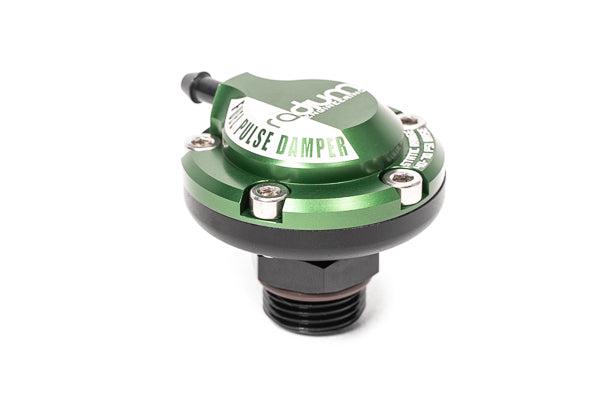
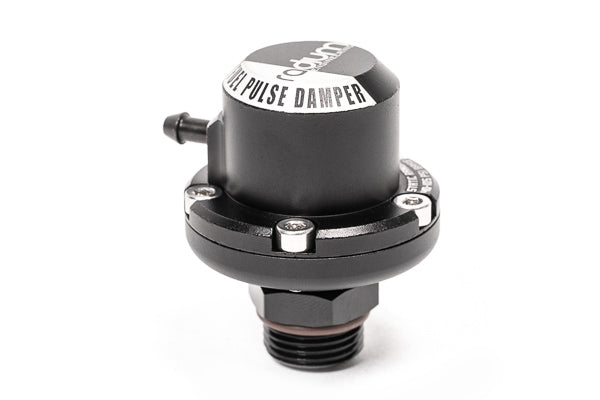
The opening and closing of fuel injectors creates pressure pulses in the fuel rail; this can lead to unstable fuel pressure. In order to achieve a safe and consistent rail pressure, a fuel pulse damper (FPD) is often necessary. The FPD's internal diaphragm will absorb oscillating pulses and stabilize fuel pressure. This correction can be measured throughout the RPM range and can often help idle surge, especially with high flow injectors. Furthermore, a fuel pulse damper can help solve erratic lean air/fuel ratio spikes, commonly experienced as stumbling, that are difficult to tune out.
Fuel pulse dampers can be mounted at any angle, including upside down. There are many variables that dictate if a fuel system requires fuel pulse dampers. For instance, there are cases where multiple dampers are necessary. There are also other times when the fuel system benefits with a fuel pulse damper on the return line.
This product is safe for use with all fuel types including alcohol blends such as E85.
DAMPERS CAN NOT BE USED WITH MECHANICAL FUEL PUMPS.
DAMPERS CAN NOT BE USED WITH DIRECT INJECTION.
Mechanical fuel pumps and direct injection high pressure pumps create very intense pressure pulses that are and too strong for the diaphragms inside of pulse dampers. These pulses will rupture diaphragms in very short time.
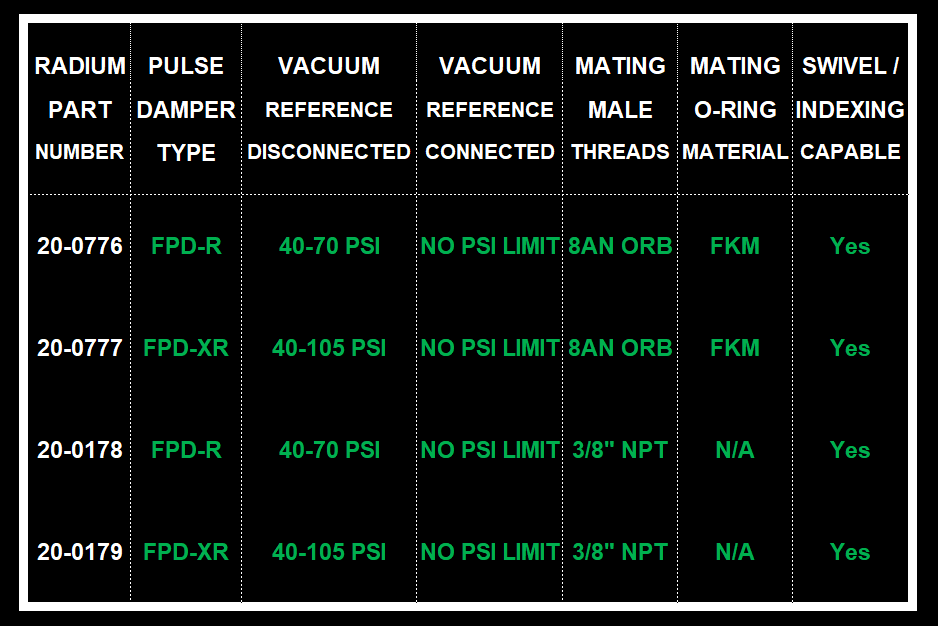
20-0776 FPD-R 8AN ORB
Standard Operating Range: 40-70psi
Standard operating range should be used on vehicles with a base fuel pressure between 40-70psi. If fuel pressure is static (does not fall or rise with manifold pressure) then no vacuum reference line is needed. If fuel pressure rises or falls lower or higher than the operating range, a vacuum line is needed.
20-0777 FPD-XR 8AN ORB
Extended Operating Range: 40-105psi
Extended operating range should be used on vehicles with a base fuel pressure above 70psi and up to 105psi. If fuel pressure is static (does not fall or rise with manifold pressure) then no vacuum reference line is needed. If fuel pressure rises or falls lower or higher than the operating range, a vacuum line is needed.
20-0178 FPD-R 3/8" NPT
Standard Operating Range: 40-70psi
Standard operating range should be used on vehicles with a base fuel pressure between 40-70psi. If fuel pressure is static (does not fall or rise with manifold pressure) then no vacuum reference line is needed. If fuel pressure rises or falls lower or higher than the operating range, a vacuum line is needed.
20-0179 FPD-XR 3/8" NPT
Extended Operating Range: 40-105psi
Extended operating range should be used on vehicles with a base fuel pressure above 70psi and up to 105psi. If fuel pressure is static (does not fall or rise with manifold pressure) then no vacuum reference line is needed. If fuel pressure rises or falls lower or higher than the operating range, a vacuum line is needed.
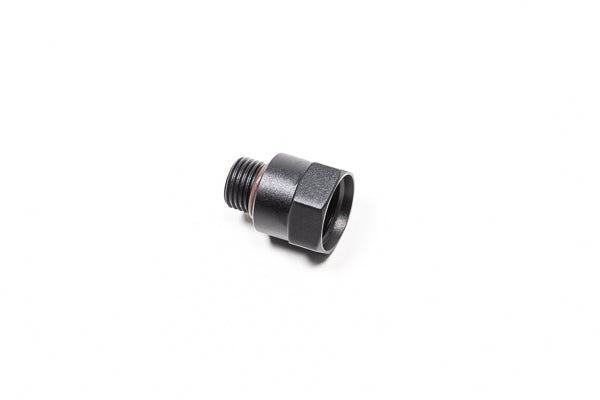
14-0600 6AN ORB Male to 8AN ORB Female
Use this adapter to adapt either of the 8AN ORB direct mount pulse dampers to a smaller 6AN port.
UNIQUE DESIGN
Along with having the flexibility of using common fittings, Radium Engineering FPD's use a vacuum/boost reference port which allows for proper fuel pulse damper performance even at elevated fuel pressures. This becomes essential for boosted systems that use a 1:1 rising rate fuel pressure regulator and in vacuum referenced regulators when fuel pressure falls under 40psi.
HOW TO CHOOSE BETWEEN FPD-R VS FPD-XR
The FPD-R (Standard Range) and FPD-XR (Extra Range) both have unique base/static fuel pressure requirements:
- FPD-R base pressure requirement = 40 - 70psi (static)
- FPD-XR base pressure requirement = 40 - 105psi (static)
Base pressure is the fuel pressure measured when the fuel pump is running WITHOUT a vacuum line connected to the regulator.
You should choose the damper that has a range that covers your base fuel pressure. If your base fuel pressure does not exceed 70psi, there is usually no advantage to using the extra range unit. The exception to this would be if your rising rate pressure exceeds 70psi, but never exceeds 105psi, and your falling rate under vacuum never moves under 40psi. In this scenario, the extra range damper would allow you to run without a vacuum line where the standard would require one.
IMPORTANT:The ranges above are base static fuel pressures only. Any dynamic fuel pressure created by a rising-rate FPR outside of this range is acceptable, but only when the base "static" fuel pressure is set within these ranges and the vacuum/boost reference line is connected.
Example 1
Vehicle: Mitsubishi EVO
OEM Base Static Fuel Pressure: 43.5psi
Boost Pressure: 30psi
Rising Rate Pressure Regulator? Yes
Can I use a FPD-R? Yes. Even though fuel pressure is 73.5psi at full boost and could be less than 40psi under vacuum, the FPD-R will work because the base static pressure was set within the 40-70psi requirement. However, the vacuum/boost reference line must be installed.
Can I use a FPD-XR? Yes. Also, the vacuum/boost reference line does not need to be installed since maximum fuel pressure does not exceed 105psi, but may need to be connected since it could fall under 40psi in vacuum.
Example 2
Vehicle: BMW E46 M3
OEM Base Static Fuel Pressure: 72.5psi
Boost Pressure: 20psi
Rising Rate Pressure Regulator? Yes
Can I use a FPD-R? No. Base static fuel pressure exceeds the 40-70psi requirement.
Can I use a FPD-XR? Yes. Also, the vacuum/boost reference line does not need to be installed since maximum fuel pressure does not exceed 105psi and won't fall under 40psi in vacuum.
TESTIMONIAL
"Just wanted to say thank you a ton. That FPD-R solved every issue I had with lean spots in my entire rpm range after removing the stock damper a while back.
I even installed it on the return side of the rail near the regulator, and it didn't make a difference as you stated. This $85 part seriously just cured a $h!tload of hassle I've had; my tuner has tuned it all and couldn't tune these spots out. I only wish folks realized how important these are with certain fuel systems (namely upgraded systems still running batch injection vs sequential)
Thank you again. You rock!"
- Dylan K.